
About us
A tiko in Vác, with a roaster
I grew up in Costa Rica, among s. I came to Hungary at eighteen, for two months. I've been here more than fifteen years.
- RoasteryVác, Csatamező út 1.
- MachineAillio Bullet R1
- Batch size888 g
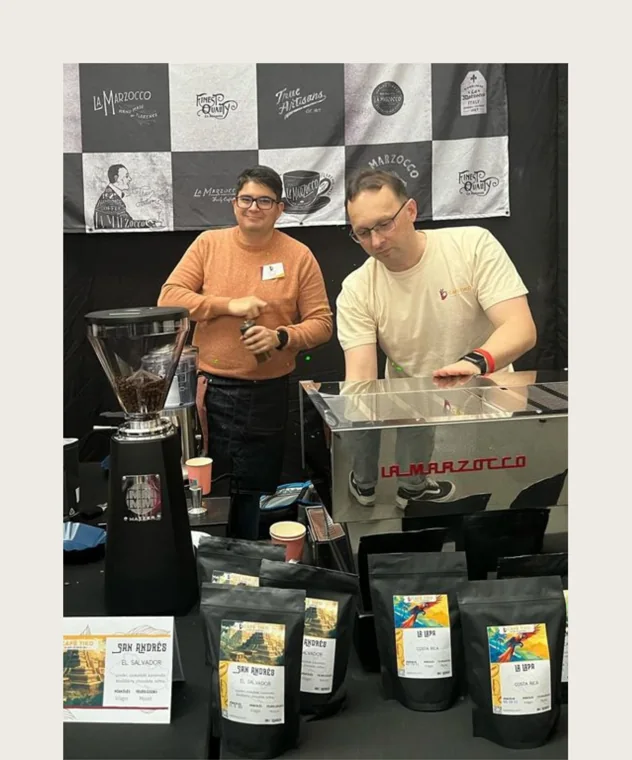
"I picked coffee before I ever roasted it."
There are two of us
- José
- The coffee half. A ; he roasts and he cups.
- Ricsi
- The Hungarian half. He is the one who rang a few days after that evening in January to say let's do it.
Coffee was never a choice
In Costa Rica coffee isn't a hobby or a niche. It's in the kitchen, in the afternoon, in how you receive people. As a child I picked coffee for two weeks each season on a family friend's farm — long sleeves in tropical heat so the branches and the insects wouldn't tear up our arms. It was hard work, but the mood was good, and at the break they brought out coffee and home-made bread. Afterwards we went hiking, or to a lake.
I was not a coffee picker. I was a child who was taken along to pick. But I know how the rows smell, and I know what a harvest sounds like. That is more than most European roasters can say — and less than gives anyone the right to speak on behalf of pickers.
Then came Hungary
I arrived as an exchange student. I liked the country, the people, the language — I learned Hungarian well enough that people are still surprised I wasn't born here. I started working, spent ten years in IT, and all the while missed the coffee I knew from home.
One evening in January I said all this to Ricsi, who I'd worked alongside for years. A few days later he rang to say let's do it. That's how Café Tiko started. He's the Hungarian half, I'm the coffee half — and five years on it still works.
I've been roasting for four years
The company is a year older than the roasting. I started because I didn't want someone else deciding how the coffee I sell should taste. Today I work on an Aillio Bullet R1, in 888 g batches — that makes three 250 g bags and one sample for me to taste.
I log every roast. Not to turn it into science, but because after ten years in IT that's simply how I work, and because my memory is less reliable than my notes. Sometimes I go back through the old curves and find that something I was sure of isn't true. That's the good part.
A beautiful curve is not the product. The cup is.
There is one thing I don't measure
The . That's how coffee is made in Costa Rica: a wooden stand, a cloth sock, hot water. No recipe, no scales, no thermometer. That isn't what it's about. My grandmother made it this way, and so did my aunts, all of them.
The man who writes everything down measures exactly one brew not at all — and that's the one that tastes like home.
Where to find us
We have no shop. We roast in Vác, we're at the market on Saturdays, and we ship from the webshop. With a few cafés we run tastings and coffee training — that's the best part of all of it, because that's where the real conversations happen.
If you come to the stand, ask for a blind comparison. The same coffee, two roasts, and I won't tell you which is which. Often the one I expected doesn't win.
— Jose Francisco Brenes Vargas
What we believe
Four things
The cup decides
If a beautiful curve makes bad coffee, the curve is wrong. We always taste it.
One sack, one story
We don't blend. Every lot is from one producer, one harvest.
You don't need to be an expert
Specialty coffee isn't an exam. Ask us anything.
We say so when we were wrong
Sometimes the data says something other than what I believed. We say that too.
Taste it and decide for yourself
The fastest way: one green coffee, three roasts, side by side.
Three-roast pack — 4,990 Ft